Introduction
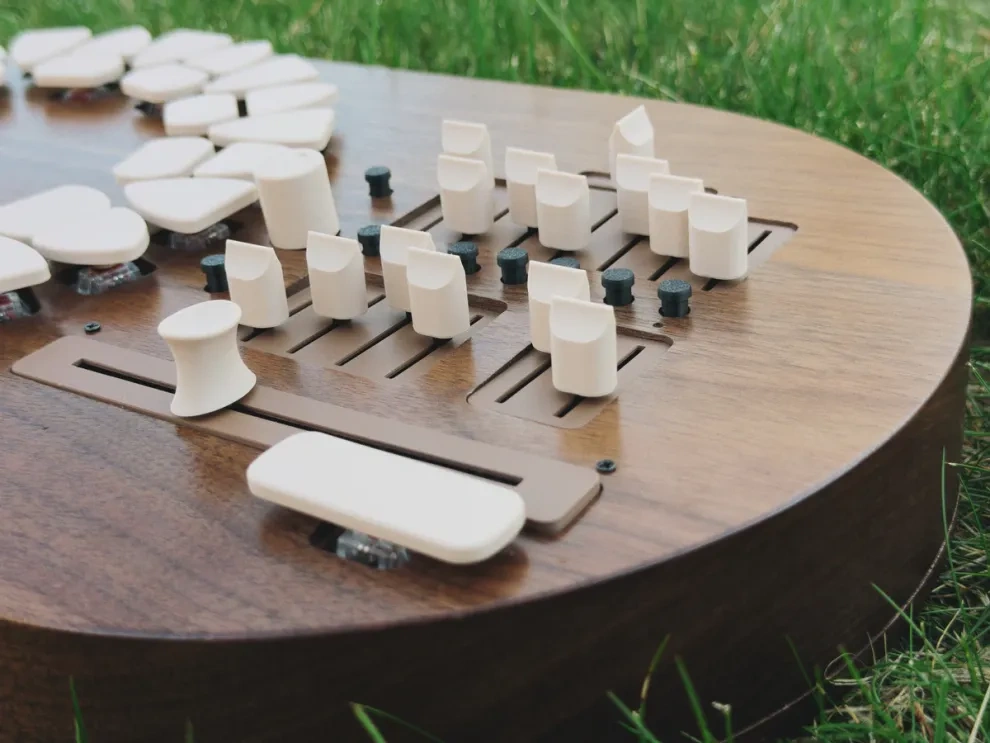
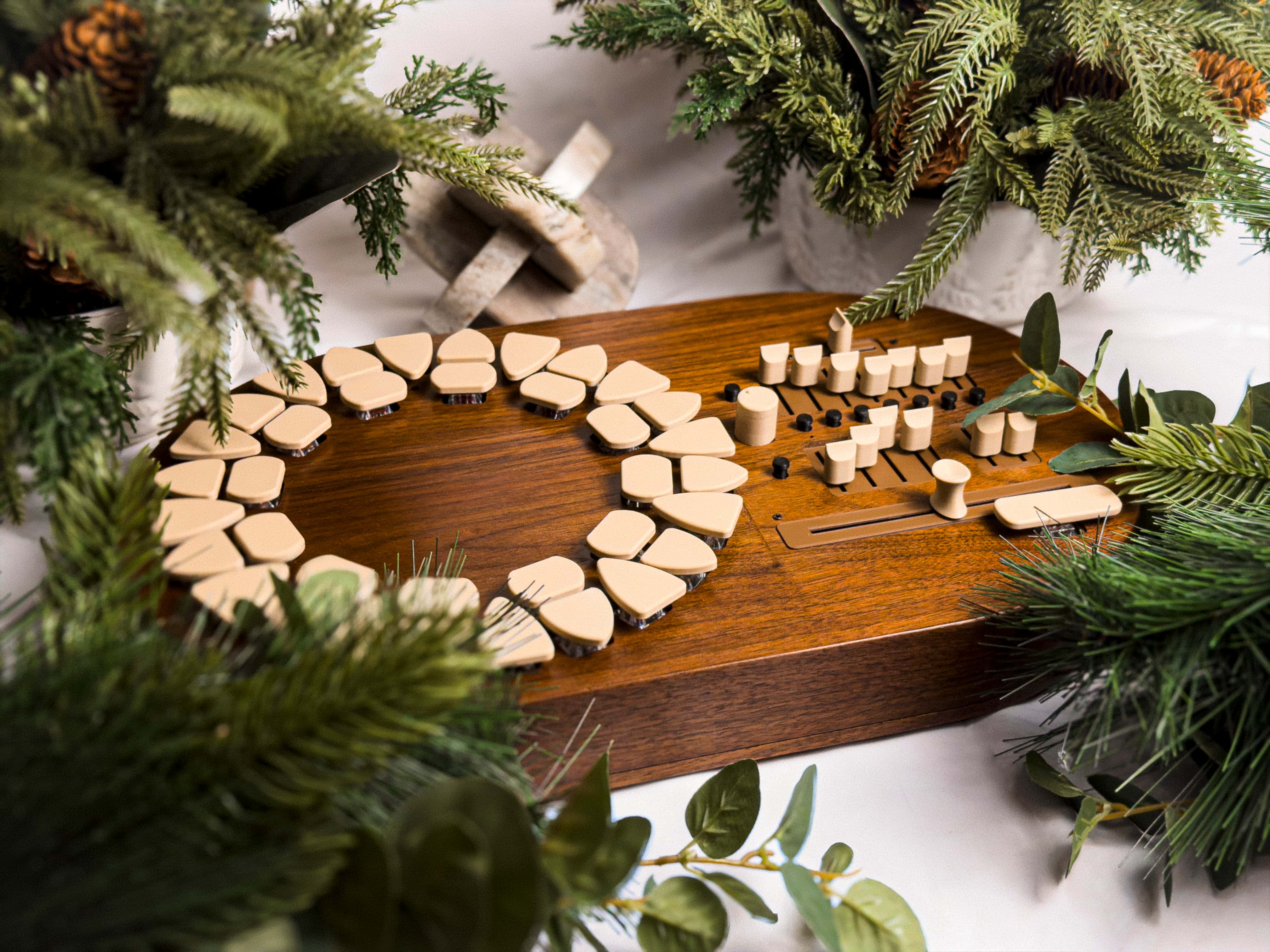
Turn music theory into a tactile experience. Press chord buttons arranged in fifths, shape each overtone with seven faders, and strum the manual arpeggiator. Three synthesis models (additive/FM, subtractive, granular) are available, and the solid walnut body can act as its own speaker.
Features
- Chord grid – Major, minor, diminished triads. Combine adjacent buttons for 7ths, 9ths, ♯11ths, 13ths.
- Shift button – Play only the root of any chord, then build complex voicings note by note.
- Harmonic engine – Seven faders control the first seven partials. Detune or add FM per partial.
- Filter envelope – Two‑stage (attack + decay) with adjustable slope and cutoff.
- Manual arpeggiator – Slide the lever left/right to trigger only the chord’s notes. Fast jumps skip intermediate notes.
- Three playback modes – Instant trigger, bass line, or arpeggiator‑only.
- Two alternative sound models (hold both function buttons)
-
Subtractive – Triangle, PWM, sawtooth, sine/FM oscillators + low‑pass filter.
-
Granular – Focus on the first four partials with spray, grain size, and jitter controls.
- Built‑in reverb – Decay time + dry/wet mix.
- Body as speaker – Internal surface sensors turn the walnut shell into a warm, resonant speaker.
Specifications
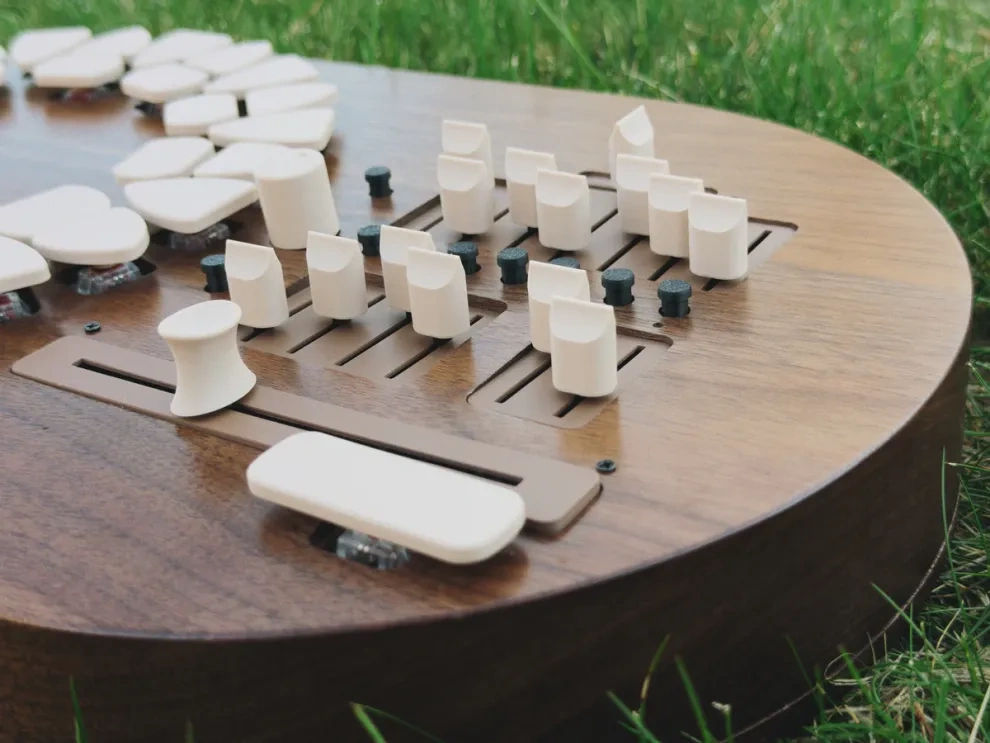
- Body – Solid American walnut, hand‑assembled
- Keys – Cherry MX Silent Red switches (quiet, tactile)
- Power – 4x rechargeable AA batteries (included) or USB‑C (4–17V)
- Connectivity – USB MIDI + stereo ¼” audio outputs
Box contents
- 🎹 Instrument body (walnut shell, batteries pre‑installed)
- 🔋 4x rechargeable AA batteries
- 🔌 USB‑C cable
- 📘 Quickstart manual (chord diagrams & shortcuts)
- 🧽 Microfiber cleaning cloth
- ✨ Hand‑signed authenticity card